I was reading these days The Model Thinker by Scott Page, where he discusses various different models, and I stumbled upon the Paradox of Cooperation, a concept mainly from evolutionary biology. It asks a simple, brutal question:
If natural selection favors the survival of the fittest, why would any individual help someone else, sometimes at a cost to themselves?
Martin Nowak, a professor of biology and mathematics at Harvard University, defined four mechanisms that provide a scientific "solutions" to this paradox. These mechanisms outline the conditions under which the math flips, making it more “profitable” to cooperate than to be selfish:
-
Repetition: If we are likely to interact again, my current move becomes an investment in your future response. Cooperation becomes a long-term optimization strategy. I do you a favour, so you would do me one in the future.
-
Reputation: I help you not for what you’ll do for me, but for what others see. Reputation is a social currency.
-
Local Clustering: Cooperators thrive when surrounded by other cooperators. If you are someone that likes helping, you tend to seek for people that also like helping.
-
Group Selection: The team layer. A selfish individual might win inside one group, but a cooperative group will outperform a selfish group when facing external competition.
I started thinking about how these mechanisms apply to the everyday world, especially at work. A useful analogy in my case might be:
Why would a “rockstar” engineer cooperate when she could claim all the fame?
In the same context and through similar analogy:
-
Repetition: We work better with people we’ve worked well with before. That’s why, when changing companies, we often try to bring trusted colleagues with us. People who have worked together in the past in the long run tend to outperform any individual rockstar.
-
Reputation: Nobody wants to be seen as selfish or difficult to work with by the team or the wider organization, so we overcome our selfishness to be liked by others (maybe we are still selfish in that regard, but for other reasons).
-
Local Clustering: In a massive, toxic enterprise where most people do the bare minimum, a small group of driven individuals might come together to push improvements,clearer processes, better tools, etc. That progress would be impossible for a single selfish actor.
-
Group Selection: Teams matter. A lone “rockstar” might shine inside a group, but a high-trust, cooperative team will consistently outperform a collection of individual heroes.
Ok, we didn't learn anything new practically, intuitivly we know that a team of people who cooperate well can outperform a selfish individual, no matter how good this person is, so let's add some more (cooperative) people to that team to speed things up right? Not really.
Here comes the second paradox that came up in my mind, the Paradox of Collaboration. Unfortunately I can't remember where and when I read about it (probably was on X by someone) but the idea stuck with me. Anyway, it suggests that while collaboration is necessary to solve complex problems, the "cost of coordination" often eats the "value of the output."
I truly believe that in many cases in modern world, we over-collaborate. We introduce meetings, consensus-seeking mechanisms, burreucratic governance, layers of management and documents and more documents... only to find that the individual’s ability to execute is paralyzed. Some of the ceremonies of SCRUM for example, feel a lot like that.
The paradox is that more collaboration often leads to less cooperation, and for sure lower productivity. When the group becomes too large or the "value" of individual contributors is obscured, the "Free Rider" problem starts appearing. Some individuals start cooperating and contributing less, either because of lazyness "Someone else will do it" or because of low motivation "My contribution is so small, noone will notice".
All these drove me to revisit a book that I read many years ago, a book that is 50(!) years old by now, The Mythical Man-Month. The central thesis of the book is Brooks’s Law which states that "Adding human power to a late software project makes it later".

The formula often used to describe the cost of communication in a team of size (n) is:
where n is the number of people in the team.
To see the "Paradox of Collaboration" in action, we can look at the Net Productivity () of a team, lets say a team of software engineers + PM + designer etc. If is the individual benefit of one person and is the cost of maintaining one communication channel:
- Linear Gain (): More hands means more raw coding power.
- Quadratic Loss (): More hands means exponentially more meetings, emails, merge conflicts, design aligments etc.
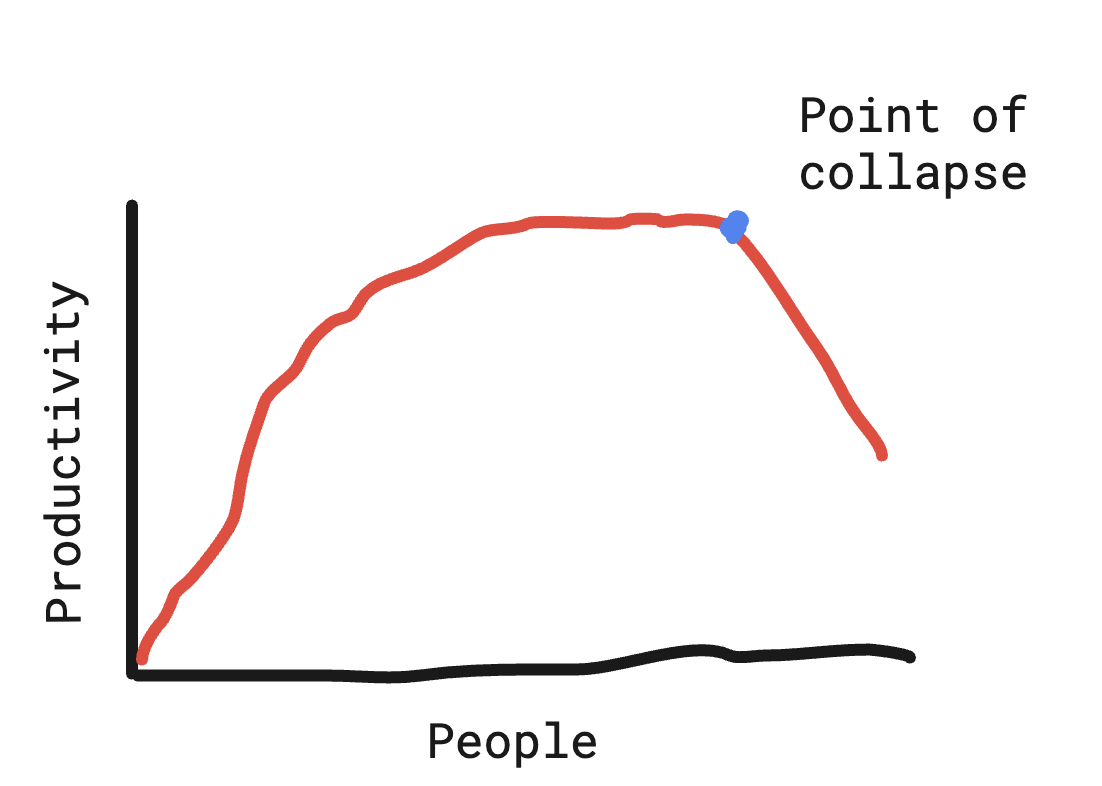
The point of collapse is when the paradox peaks, when adding the hand actually reduces the total productivity . This happens because the cost of the new communication channels created by that person is greater than the work they contribute. In my "scientific" graph, something like this:
In the age of AI agents, the variables in our equations are shifting, but the underlying "geometry of cooperation" remains the same. We are moving from a world of Human-to-Human (H2H) interactions to a world of mainly Human-to-Agent (H2A), or better to a world with some H2H and some H2A. In the age of agents, the "Two-Pizza Team" might become the "One-Pizza Team" while velocity is the same (or even greater).
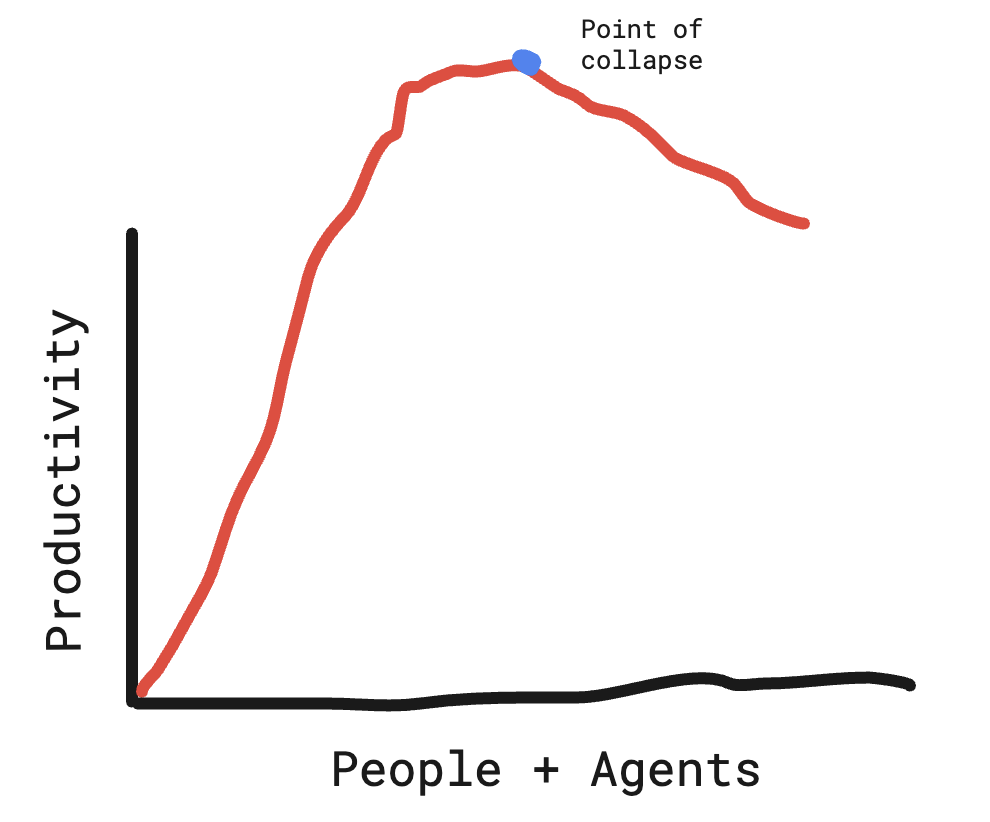
If the cost of coordination () is the primary reason projects are slow, and AI agents reduce by automating the "syncing" between tasks, then the optimal team size () naturally shrinks. Consequently the math suggests that we will move toward "Hyper-Small, Hyper Leveraged" teams. The tools may help us keep notes, summarise, track... but effectively we are becoming the bottleneck, because our context capacity is limited. Although productivity goes higher, the point of collapse happens earlier, again in my "scientific" drawing something like this:
Collaboration isn’t magic. It’s math. And the same math warns us that collaboration has limits. As AI reshapes how much value an individual can produce we’ll need to rethink what “teams” even are. We shouldn’t assume that adding more people (or more processes) makes anything better. AI is rebalancing the equation. To keep the trust, creativity, and joy of working together, while stripping away the drag that turns teammates into bystanders we need clearer missions, more flow, and in many cases less collaboration. Paradoxically, this will feel more human, not less. Why? Because we will be working closer together.
It is natural to feel a sense of "technological anxiety" when the math suggests we need fewer hands to do the same work. However, there is a deeply optimistic truth: as the "cost" of technical coordination drops, the value of "human" qualities skyrockets.
When we no longer have to spend 80% of our energy acting as routers for information, syncing JIRA tickets, repeating requirements, navigating bureaucracy, we are finally freed to do the work we were actually built for.
The "One-Pizza Team" isn't about exclusion. It’s about returning to a state where every person in the room has total context, deep agency, and the ability to see their fingerprints on the final product. In this new equation, the value shifts from "how much code can I ship" to "how much vision can I provide." (More on this soon)