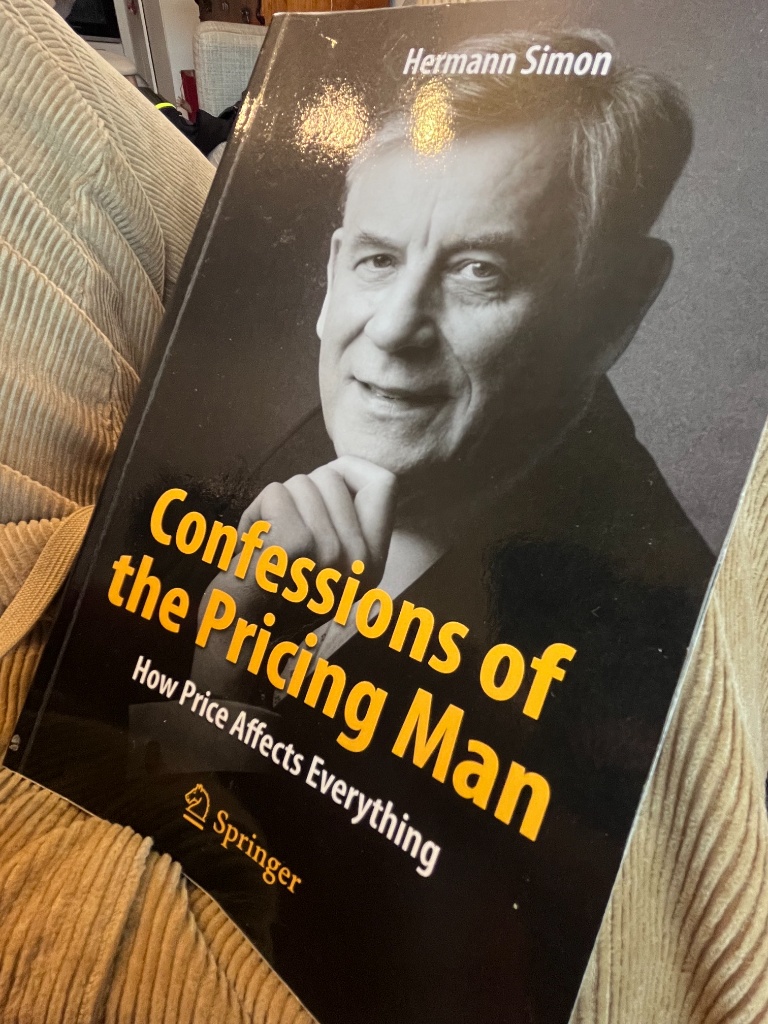
During the Christmas period I had the chance to read Hermann Simon's Confessions of the Pricing Man. I admit, I expected a dry, academic manual on economics. Instead, I found a philosophy book disguised as business strategy. As I turned the pages, I realized that he wasn't just explaining the history of pricing, mentioning tactics and strategies of pricing with stories from various companies, he was sharing lessons that are timeless. The lessons from the book will be applicable also in the upcoming Agentic AI economy.
We have spent the last decade in the "SaaS Seat" era, paying for access, e.g. in Figma you pay per designer seat. But as I looked at my highlights, it became clear why that model is dying and why the "Work Done" model is the only logical successor.
Early in the book, Simon quotes Warren Buffett on the single most important decision in business:

When I read this, I immediately thought of the current wave of "AI Co-pilots." In the traditional SaaS world, vendors are terrified to raise prices because they are selling a commodity: seats. If Figma raises the price of a seat, we groan. We feel the pain immediately because we are paying for access, not a guarantee of value.
In the Agentic world, pricing power returns. If an AI agent can autonomously close customer support tickets or fix bugs 24/7, the vendor has immense pricing power. They don't need a "prayer session" to charge for that value.
The most naive way to define a price is to calculate our costs and add a margin. Simon calls this out as a fallacy, referencing Marxian theory:
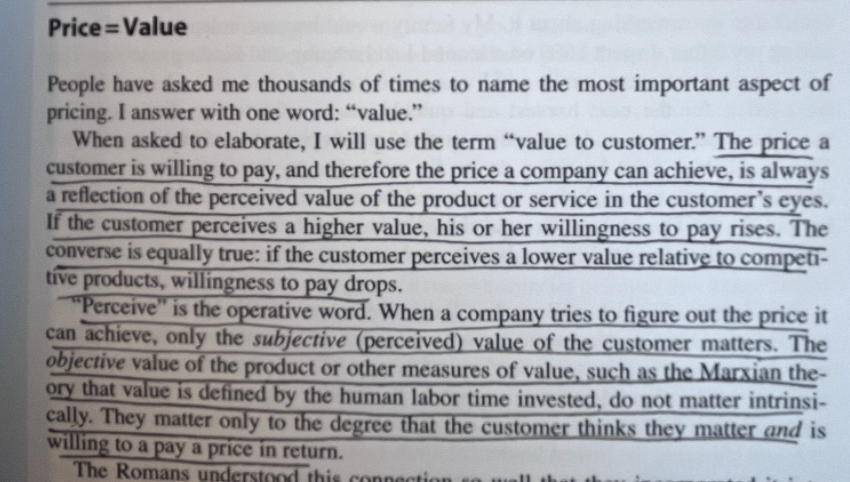
Simon explicitly states that the "labor time invested" (or in our case, the inference time) does not matter intrinsically. Customers do not care if the Agent took 1 second or 1 hour to negotiate a refund. They care that the refund is negotiated.
This confirms that the industry must move away from "usage-based" (paying for tokens) toward "outcome-based" (paying for results). The customer's "willingness to pay" is tied to the result, not the compute labor. Reliability becomes a product differentiation, it will not matter if your product use AI, it will not matter if the whole product is AI itself, what will matter is how reliable the agent you have built is.
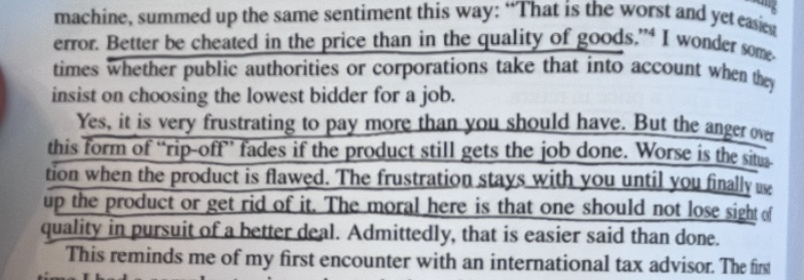
The "Race to the Bottom" in AI pricing might be short lived. Customers will not pay for the cheapest agent, will pay for the one that actually works. Customers will happily pay a premium "outcome fee" to an agent that guarantees quality, rather than a low "usage fee" for an agent that requires constant supervision.
We are moving toward a world where we treat software less like a utility bill and more like a contractor's invoice. If you are building in this space, stop obsessing over margins. Start asking what the "Perceived Value" of the completed task is. My prediction, most SaaS will have a single pricing model: small base fee + work done by agent.